

The Best Way To Survey
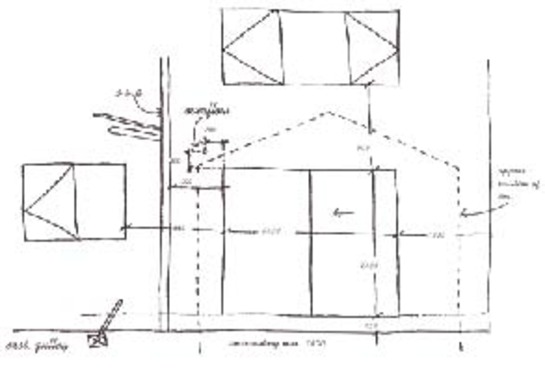 The best way to carry out your survey is to initially sketch up a plan view and elevation view of the proposed site of the conservatory showing all existing windows, pipes, drains, soil pipes and any other possible obstructions. The following points are provided as a guide and are not intended as survey instructions. If you have any doubts we will be happy to discuss any points with you if we can help or you could consult a professional surveyor.
Before you start your survey we recommend that you lay out the conservatory in it's intended position using cane sticks or a simple string line to replicate the footprint of the external dimensions of the structure.
Entrance from the house
Many customers choose to replace an existing french or patio door at the time of installation of their new conservatory but please be aware that in order to comply with current building regulations, the door must be an external type door that complies with building regulations.
Internal Sizes vs External Sizes
Note that the internal size quoted by any conservatory supplier is normally the internal frame size(internal face of the external brickwork)and not the internal floor size which will depend on the size of the cavity you require and the internal brick or blockwork size. For manufacturing purposes the internal frame sizes are used to set out the conservatory.
Is the existing house wall plumb?
Always check that your house wall is plumb. If it leans in or out adjustments will need to be made to either the conservatory roof or the dwarf wall at the design stage to ensure a trouble free installation.
Gas Flues
Diverting fumes from an existing gas flue is not recommended and you should consult a registered gas installer for assistance. It is recommended that a gas flue is a minimum of 300mm away from the conservatory wall and a deflector is fitted to avoid constant heat aimed at the PVCu frames.
Soil Pipes
You will need to provide accurate dimensions of the position, size and distance off the house wall so that we can provide the best solution.
Underground Drains
Underground drain pipes need not be a problem as they can often be rerouted but you should seek professional advice. It is not always possible to move manholes but it should be possible to raise the height of the manhole and fit an internal cover. These can be obtained with a tray top which will accept tiles or carpet to disguise the cover. If you are using a builder to construct your base they will normally be happy to advise and undertake any changes for you.
Sewers
If your conservatory is being built over a public sewer you will need a 'Building over a sewer agreement' obtainable from your local Building Control authority.
Is there a height restriction?
Check the height of any windows or other obstructions that are above the intended site of the conservatory. The pitch of the roof can normally be lowered to accomodate. The CAD drawing provided with your quotation will provide the height dimension from dpc to the top of the ridge excluding cresting and finial. It is recommended that you add 100mm for the ridge flashing trim and the flashing itself. The cresting and finial are higher than the flashing trim but this is not normally critical when considering the height of the roof unless there are any side hinged open out windows above the conservatory.
Box Gutters
For double hipped conservatories that join the main house using a box gutter it is important to check the positioning especially if the new box gutter is being fitted to the existing soffit. This will require the conservatory frames to run under the soffit so it is vital that depth of soffit, height of fascia board and height to underside of soffit from dpc are provided. Box gutters are usually 165mm wide but a 265mm width is also available for providing extra capacity for collecting from two large roofs etc.
Bungalows
If your conservatory is being fitted to the existing bungalow soffit it is important to lift the lower roof tiles and inspect the felt. If the felt has deterioated it is recommended that this be replaced before installation to prevent any possiblility of water ingress into the conservatory. Soffit and fascia boards may also require replacing prior to installation.
Rainwater Outlet
Determine the position of the outlet and whether this will link an to existing system or if a new soakaway is required.
Ventilation
South facing properties endure long hours of constant sunshine during the summer months and we recommend that you consider specifying a manual or electric roof vent and additional opening window vents to ensure maximum ventilation during the summer months. Check out our Climate Control page for guidance on ensuring your conservatory becomes an all year round extension to your home.
Conservatory Door Position
The position of your conservatory door needs to be carefully considered. Many customers request a french or bifold door in the front centre elevation normally opening directly out into the garden. If you choose this position it will however create a defined passage way through your furniture. It may be preferable to consider locating the door to the side elevation nearest the house wall to maximise the use of the floor space and also provides the shortest path to the exit from the house.
Replacing An Existing Conservatory
If you are replacing your existing conservatory and building onto an existing base it is important to ensure that the brickwork and the base itself are structually sound. For Edwardian, Gable End and Lean to conservatories the brickwork return angles should be 90 degrees and for Victorian and Gullwing conservatories angles should normally be 135 degrees. That said, many customers find that the angles and facet lengths of their existing conservatories are often not as accurately constructed as you would expect them to be and an angle finder and some careful measuring will be required to determine the exact base sizes.
Access to the site
Think about delivery access to your intended site especially if your house is terraced. For confined access a steel base may be the best solution.